01
The stones sit on the intersections
Go stones are placed where the lines meet. A stone connects to a same-color neighbor directly above, below, left or right. Diagonal neighbors do not connect in the same way.
The small board in the example below gives you one local problem to inspect. Follow the empty neighboring points around the pale stone before placing the final dark stone.
02
Try one capture
The pale stone in this example has three dark neighbors and one empty neighboring point. That last open point is its remaining liberty. Place a dark stone there and the pale stone is removed.
The button demonstrates just this capture. A complete Go game also involves connected groups, territory, legal-move checks and the chosen scoring rules.
The dotted point is the pale stone’s last liberty. Place a dark stone there to see this capture.
A teaching example, separate from the Gopetal app.03
Choose a small practice game in Gopetal
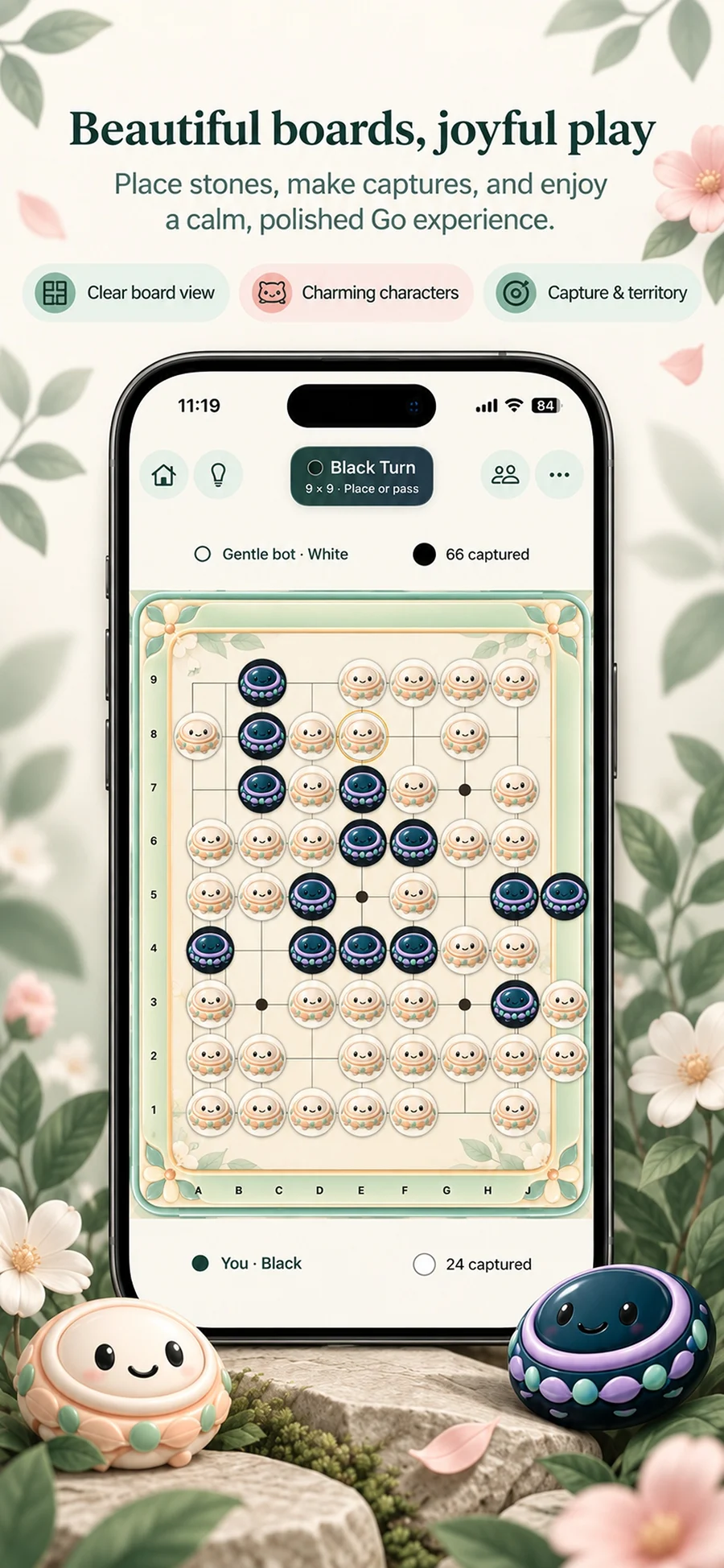
Gopetal offers 9×9, 13×13 and 19×19 boards. Choose 9×9 for this exercise and start local bot practice at a difficulty you find comfortable. Gentle, Balanced and Advanced are available choices.
The app’s visual lessons cover placement, liberties, captures, atari, passing and scoring. Use the guided 9×9 practice game to connect a lesson to a position on the board. Gopetal is part of the Petal collection; its product page shows which editions have been released.
- Start with a 9×9 board.
- Find a group with only one open neighboring point.
- Try to connect your own stones and preserve open points around them.
- After a capture, look again: the removed stones leave new empty intersections.
04
Finish by reviewing the board
Gopetal uses area scoring, positional superko, no suicide and 7.5 komi for White. After two passes, players review dead groups and confirm the score, or resume play. These are Gopetal’s documented rules; other Go rulesets can handle scoring and repetition differently.
For a first local game, let the app handle its legal-move checks while you work on recognizing groups and liberties. When the scoring review appears, take time to inspect the marked groups instead of treating it as another move.
05
One useful question for the next game
Before each move, ask: which group am I helping, and how many liberties will it have afterward? You can use the same question when reviewing an unfamiliar position.
Move to a larger board when you want more space to explore. Staying on 9×9 is also a valid way to keep practicing; the board size is a choice, not a progress score.
For your first practice game, make one habit: count liberties before placing a stone.
Explore Gopetal Compare the Petal gamesProduct details & further reading
App-specific features reflect the maintained product information. Follow the product page for current release status and store requirements.